
Pediatric Cardiac Codes
Hands-on team simulation with web-based performance tracking
✓ Practice infant resuscitation using the equipment you already have.
✓ Designed for use in community Emergency Departments; no need for a simulation
center, prior pediatric or simulation expertise, or specialized equipment.
✓ An interactive patient monitor and a time-stamped record of team actions support the educational experience and help track team performance.
What you need to run the session
Use the equipment already available in your setting
01

The booklet
02


The mannequin
Use the mannequin you have available;
can be low fidelity
03

A computer, with an optional external monitor
Display the cardiac rhythms and animated patient for the team
04

Your own defibrillator and resuscitation equipment
practice with the equipment your team uses locally
Educational Objectives
At the end of this simulation, your team will be able to:
01
Manage an infant in cardiac arrest per Pediatric Advanced Life Support (PALS) guidelines
02
Recognize between shockable and non-shockable cardiac rhythms
03
Demonstrate high-functioning teamwork with clear role assignments and closed-loop communication
Two ways to run the simulation
One facilitator

The facilitator runs the tool, records actions, answers questions, and leads the debrief
Embedded facilitator + sim scribe

The embedded facilitator observes and guides the team.
The sim scribe runs the tool and records actions.

Interactive Simulation
✓ Learners perform actions in situ on the mannequin
✓ The interactive video augments the simulation by providing a monitor with cardiac rhythms and vital signs, and an animation of the patient
✓ The facilitator navigates the interactive video for the team to see and can also click on the video to timestamp team’s time-critical actions (optional)
✓ Interactive video also includes a recorded debrief, patient dispatch and 2 minute countdown clock, guided debrief, and a cardiac arrest reference guide to help with the simulation facilitation
Cardiac Arrest / Asystole
An infant arrives unresponsive and pulseless.
Performance tracking
✓ The facilitator or sim scribe records observed actions. The tool timestamps each entry.
✓ Track performance over repeated sessions for education and local improvement.
✓ We recommend having a dedicated person timestamp the team’s actions for higher accuracy.
During the scenario
Select the corresponding control as each action occurs. Record compression starts and stops using the toggle.
The summary includes
✓ Epinephrine timing
✓ Defibrillation, when applicable
✓ Recorded compression interruptions
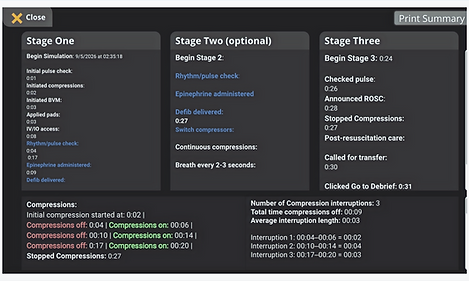
Interface demonstration. Shown values are not study results.
3. Surveys
Please complete the facilitator and participant surveys at the end of the session to help us improve SimBox.


Developed with general emergency deparmtents
✓ General ED Pediatric Emergency Care Coordinators
✓ Pediatric emergency medicine and critical care physician and nurse simulation educators and
instructional designers
✓ refined this resource through multiple iterative cycles of local testing and feedback.
04
General emergency departments
17
Training
sessions
20
Facilitator
surveys
Study summary
Across 17 training sessions, 20 facilitator surveys showed high acceptability (4.46/5), appropriateness (4.48/5), and feasibility (4.53/5). Mean system usability was 76.1/100. Forty-nine learners reported improved comfort. These findings describe feasibility and self-reported experience. Performance data were not quantitatively analyzed.
PARTICIPATING SITES: Bridgeport Hospital (Connecticut), Lawrence & Memorial Hospital (Connecticut), Ascension Providence Hospital (Texas), and Valley Medical Center (Washington).
Acknowledgements


Supported by the 2024 AAP Ken Graff Young Investigator Award.
With thanks to participating ED teams, the IMPACTS Network, the Pediatric Pandemic Network, and OPENPediatrics
Posted: August 2026
Revised:
Project Developers: Project Developers: Sofia Athanasopoulou MD, Becca Mielke RN, Maybelle Kou MD, Marc Auerbach MD, Erin Montgomery RN, Elizabeth Sanseau MD, Cage Cochran, Benjamin Michaels, Allie Westbrook, Bonnie Mackenzie MD, Jawal Hage RN, Marlene Schmidt RN, Kristen Glick PA, Karen Della-Giustina MD, Nathan Chupik RN, Rakesh Mistry MD
SimBox Case: Cardiac Codes- Cardiac Arrest/Asystole © August 2026 by Sofia Athanasopoulou MD, Becca Mielke RN, Maybelle Kou MD, Marc Auerbach MD, Erin Montgomery RN, Elizabeth Sanseau MD, Cage Cochran, Benjamin Michaels, Allie Westbrook, Bonnie Mackenzie MD, Jawal Hage RN, Marlene Schmidt RN, Kristen Glick PA, Karen Della-Giustina MD, Nathan Chupik RN, Rakesh Mistry MD is licensed under CC BY-NC-ND 4.0. To view a copy of this license, visit https://creativecommons.org/licenses/by-nc-nd/4.0/